RFID vs NFC: Differences in Frequency, Range & Applications
RFID and NFC are both contactless technologies, but they are designed for different physical interactions. This guide explains frequency, operating distance, reader architecture, smartphone compatibility, inventory use cases and when UHF RFID or NFC is the better fit.
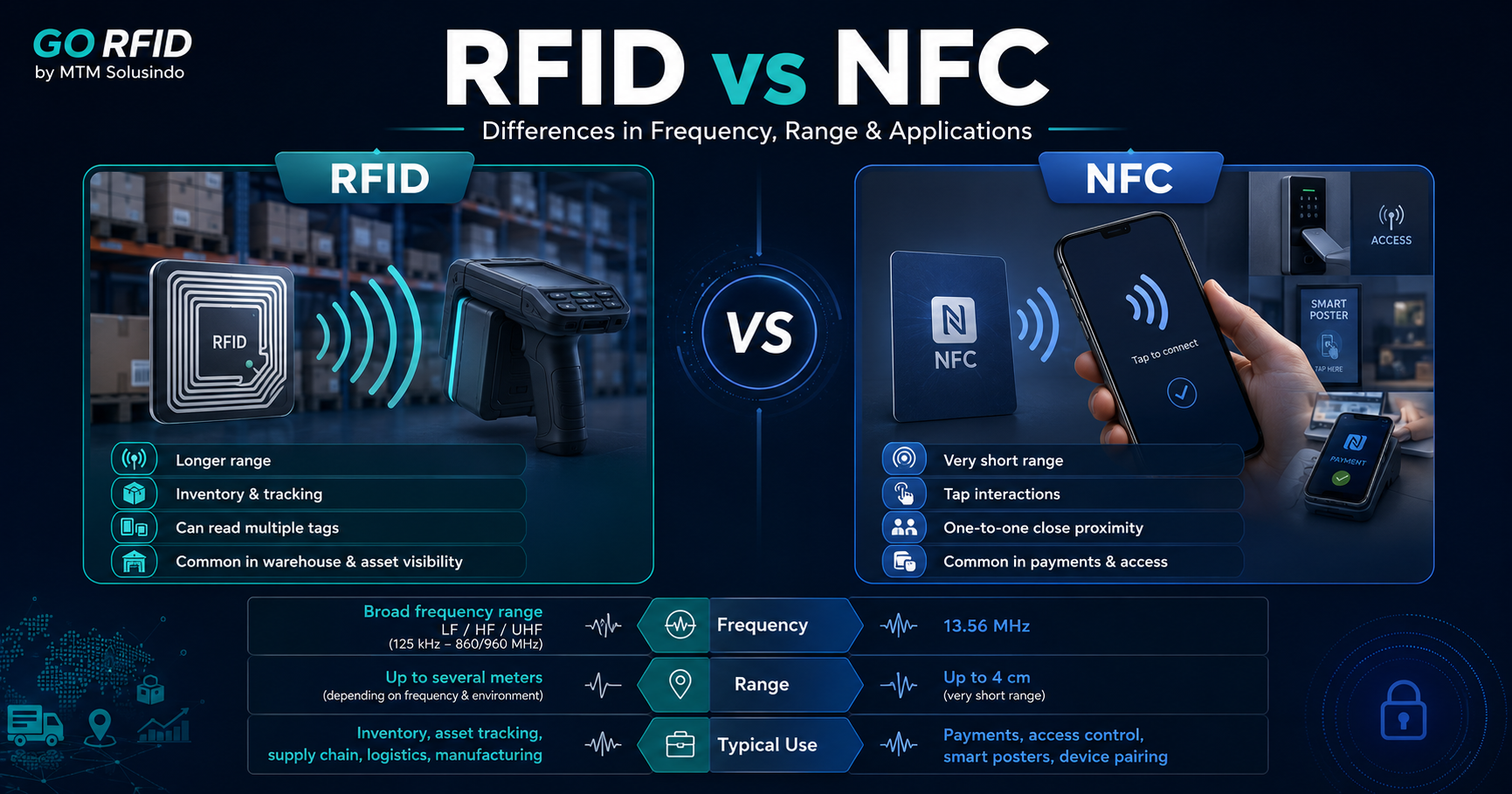
RFID and NFC are often discussed as if they were competing technologies. In reality, RFID is a broad family of radio-frequency identification technologies, while NFC is a specialized close-proximity contactless technology built around 13.56 MHz communication and tap-oriented experiences.
That difference matters when selecting technology for inventory, warehouse automation, asset identification, payments, access control or consumer interaction. A solution designed to count many tagged inventory items is very different from a smartphone tap used to open a web page or emulate a contactless credential.
RFID vs NFC: What Is the Main Difference?
UHF RFID
- Commonly used for inventory, warehouse and asset identification.
- GS1 EPC UHF Gen2 currently covers the 860–930 MHz air-interface range.
- Designed to identify populations of compatible passive tags.
- Can use handheld or fixed industrial readers.
- Can create operational read zones beyond deliberate tap distance.
- Performance depends on tags, antennas, material and environment.
NFC — Near Field Communication
- Operates at 13.56 MHz.
- Designed around very close contactless interaction.
- Commonly experienced as a deliberate tap.
- Supported by many smartphones and wearables.
- Used for payments, access, tickets and product engagement.
- Supports reader/writer and card-emulation use cases.
For the enterprise-oriented side of this comparison, see our UHF RFID technology guide.
RFID vs NFC Comparison Table
| Factor | UHF RFID | NFC |
|---|---|---|
| Technology family | RFID / RAIN RFID | Close-proximity HF contactless technology within the broader RFID/contactless ecosystem |
| Frequency | GS1 EPC UHF Gen2: 860–930 MHz, with regional regulations applying | 13.56 MHz |
| Typical interaction | Inventory, handheld scan, read zone, fixed checkpoint | Deliberate tap / very close proximity |
| Reader | Industrial fixed or handheld RFID reader | NFC-enabled phone, wearable or dedicated NFC reader |
| Multiple-tag inventory | Designed for populations of compatible tags in suitable conditions | Normally close one-to-one or deliberate interaction |
| Smartphone interaction | Not the normal UHF inventory-reader model | Core strength of the NFC ecosystem |
| Common enterprise use | Warehouse, inventory, logistics, assets, manufacturing | Payments, access, credentials, ticketing, product engagement |
| Read-zone goal | Operational coverage | Intentional proximity |
RFID Is a Broad Technology Family
The term RFID does not describe one single frequency or one single type of system. RFID systems can operate across different frequency bands and use different air-interface standards depending on the application.
GS1 describes low-frequency, high-frequency and ultra-high-frequency RFID. HF RFID commonly operates at 13.56 MHz, while passive UHF RFID used for RAIN RFID inventory and tracking operates in the UHF band.
This is why saying “RFID has a range of X meters” without identifying the frequency, tag type, reader and environment can be misleading. NFC and industrial UHF inventory RFID are both radio-based contactless technologies, but they are engineered for very different interactions.
What Is NFC?
NFC stands for Near Field Communication. The NFC Forum describes NFC around close-proximity, tap-based interaction. NFC Forum devices can communicate with compatible tags and contactless technologies based on standards including ISO/IEC 14443, ISO/IEC 15693 and ISO/IEC 18092.
NFC is particularly useful for:
- tap-to-pay transactions,
- access credentials,
- transit and ticketing,
- smartphone-to-tag interaction,
- product information and digital engagement,
- identity applications, and
- device setup and intentional tap experiences.
What Is UHF RFID?
Passive UHF RFID is designed for a different problem: identifying tagged physical objects efficiently across operational read environments.
GS1's current EPC UHF Gen2 standard, Release 3.0.1 published in February 2026, specifies an air interface in the 860–930 MHz range. Regional spectrum rules still determine reader configuration in each country.
For enterprise applications, UHF RFID can support warehouse inventory counting, pallet and carton identification, retail inventory, enterprise asset monitoring, production checkpoints and other defined read zones.
Explore the hardware layer in our industrial RFID reader guide or see how it supports RFID-based inventory tracking.
Frequency: NFC at 13.56 MHz vs UHF RFID
Frequency alone does not determine practical read distance. Reader power, tag antenna, object material, antenna placement, orientation and regional radio rules all matter.
Read Range: Why the Comparison Needs Context
NFC is intentionally designed around close-proximity interaction. The NFC Forum emphasizes the tap experience and very short connection distance. UHF RFID can instead be engineered around operational read zones across shelves, rooms, doors, dock areas or conveyor checkpoints.
In an industrial UHF system, maximum distance is not always the goal. A receiving portal should capture the intended tags without unnecessarily reading items in adjacent locations. That is why RFID antenna placement and read-zone engineering are critical.
RFID vs NFC for Inventory Management
For scalable inventory counting, passive UHF RFID is normally far more relevant than NFC. A warehouse operator can use a handheld UHF reader to identify compatible tags across a validated inventory area without intentionally tapping every item.
NFC creates a different workflow. Its strength is intentional close interaction with one tag or credential rather than broad inventory interrogation.
RFID vs NFC for Asset Tracking
If employees need to tap one specific asset with a smartphone to open its record, NFC can be a practical interaction method. If the goal is to identify multiple laptops, computers, tools or equipment across configured enterprise read zones, passive UHF RFID can be more appropriate.
See our RFID asset tracking solution and RFID for enterprise IT and equipment assets.
RFID vs NFC for Retail
Retail shows how the technologies can serve different stages of the journey. UHF RFID can support item-level stock visibility and inventory counting, while NFC can support consumer-facing tap experiences, contactless payment or product engagement.
For inventory-oriented retail applications, visit RFID for retail operations.
Can Smartphones Read RFID Tags?
Most modern smartphones include NFC capability, which allows them to interact with supported NFC tags and contactless systems. That does not make a phone equivalent to an industrial UHF RFID inventory reader.
Passive UHF RFID inventory systems generally use dedicated UHF readers designed for the relevant standard, antennas and operational read environment.
RFID Tag vs NFC Tag
Both technologies can use passive tags, but tag architecture and communication standards differ. For UHF inventory applications, tag selection depends on antenna design, object material, size, orientation, read-zone requirement and regional frequency environment.
Our UHF RFID tag technology guide explains RFID labels, inlays, EPC, TID, anti-metal tags and washable tags.
RFID Reader vs NFC Reader
An industrial UHF RFID reader can communicate with tag populations across a defined operational environment and may provide multiple antenna ports, Ethernet, GPIO or SDK support depending on the platform. An NFC reader is optimized for very close contactless interaction, and in many consumer use cases that reader is already built into a phone or wearable.
The RFID middleware layer can filter reader observations and add business context before information reaches enterprise software.
Can NFC Replace UHF RFID?
For most warehouse and high-volume inventory applications, no. NFC is designed for a fundamentally different interaction model. Requiring a worker to tap every inventory item would eliminate much of the operational advantage offered by UHF RFID.
Likewise, UHF RFID is not automatically better for a deliberate smartphone payment or close-proximity product interaction. The right technology depends on the business process.
Can UHF RFID and NFC Be Used Together?
Yes. A company can use UHF RFID for warehouse inventory or enterprise assets and NFC for smartphone, payment, access or product-engagement workflows. The important principle is to avoid forcing one technology onto every use case.
When Should You Choose UHF RFID?
Choose UHF RFID When You Need
- Higher-volume inventory counting.
- Multiple-tag identification in suitable conditions.
- Warehouse or logistics read zones.
- Asset monitoring across configured locations.
- Handheld industrial inventory workflows.
- Fixed readers connected to business software.
Choose NFC When You Need
- Intentional tap-based interaction.
- Smartphone compatibility.
- Contactless payments or credentials.
- Access-control interactions.
- Product information accessed by tapping.
- Very close-proximity communication.
8 Questions to Ask Before Choosing RFID or NFC
RFID vs NFC: Final Verdict
NFC is optimized for intentional close-proximity interaction at 13.56 MHz. Passive UHF RFID is optimized for scalable item identification across operational read zones and is therefore much more closely aligned with inventory, warehouse, logistics and enterprise asset applications.
For GO RFID projects focused on operational visibility, the typical path is: UHF tags → RFID reader and antennas → middleware → integration with the existing business system.
Frequently Asked Questions
Is NFC the same as RFID?
No. RFID is a broad family of radio-frequency identification technologies. NFC is a specialized close-proximity contactless technology operating at 13.56 MHz.
What frequency does NFC use?
NFC operates at 13.56 MHz.
What frequency does UHF RFID use?
The current GS1 EPC UHF Gen2 Release 3.0.1 specifies an air interface in the 860–930 MHz range. Actual reader configuration must comply with regional regulations.
Which is better for inventory: RFID or NFC?
For scalable warehouse and inventory counting, passive UHF RFID is normally more appropriate. NFC is better suited to deliberate close-proximity interaction with individual tags or credentials.
Can a smartphone read UHF RFID tags?
A typical NFC-enabled smartphone is not equivalent to an industrial UHF RFID inventory reader. Phones commonly interact with NFC-compatible tags, while UHF inventory typically uses dedicated UHF readers.
Can UHF RFID and NFC be used together?
Yes. A business can use UHF RFID for operational inventory and NFC for smartphone, payment, access or consumer-engagement workflows.
Does longer RFID range always mean better performance?
No. Industrial RFID should create a controlled read zone that detects the intended tags while minimizing unwanted reads from adjacent areas.
Need RFID for Inventory, Warehouse or Asset Visibility?
GO RFID by MTM Solusindo focuses on enterprise UHF RFID architecture for inventory tracking, warehouse operations, asset monitoring and integration with existing software.