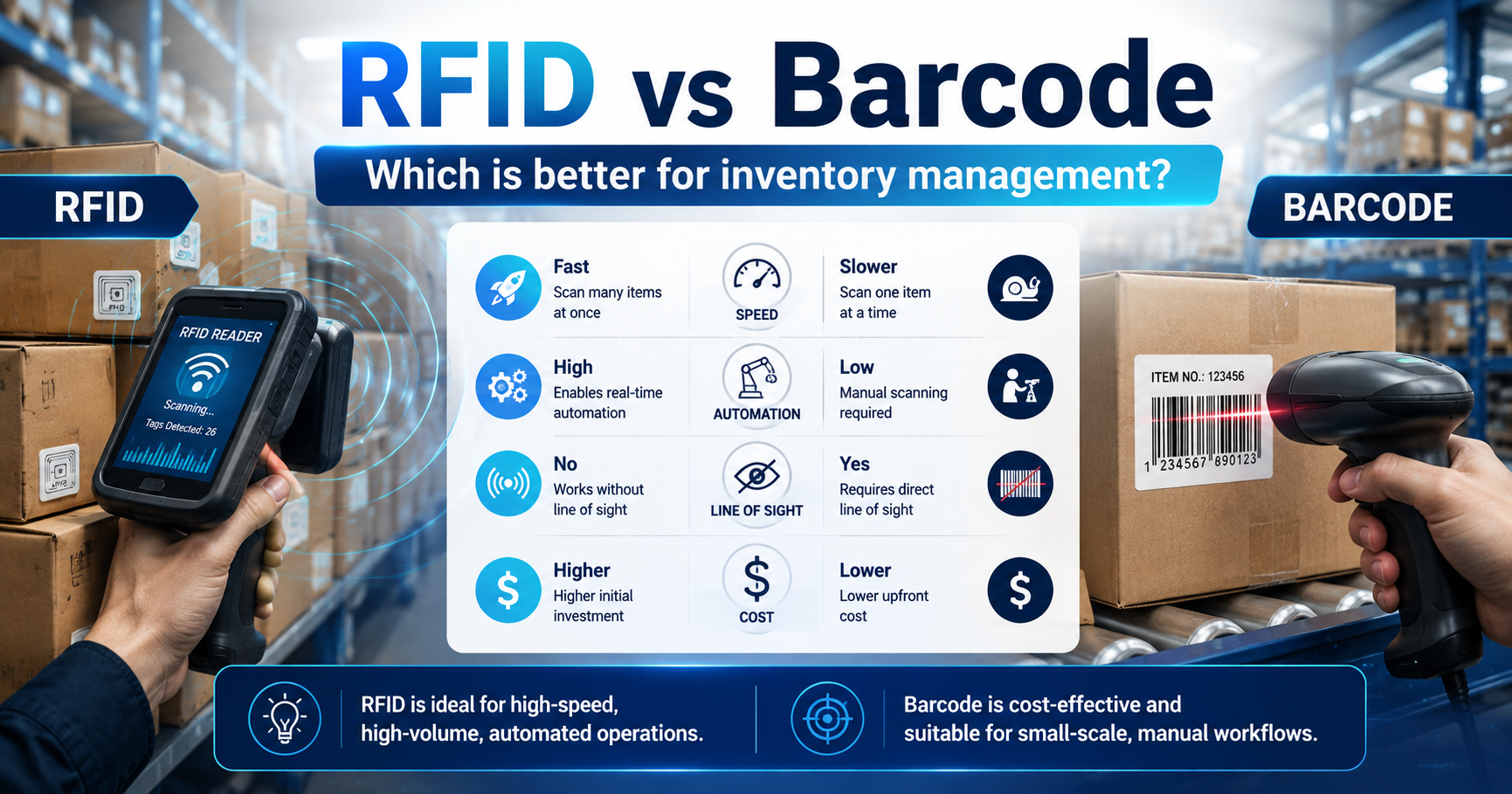
RFID vs Barcode for Inventory Management: Which Is Better?
RFID and barcode can both identify inventory, but they create very different operational workflows. This guide compares scanning, automation, cost, item-level identification, warehouse use cases and the factors that determine when RFID creates real value.

Choosing between RFID and barcode is not simply a hardware decision. It changes how employees identify items, how frequently stock can be verified, where automation can be introduced and how physical inventory events reach the software that runs the business.
A barcode normally requires an optical scanner to see a printed symbol. RFID uses radio-frequency communication between a reader and a compatible RFID tag. That distinction is the foundation of the RFID vs barcode for inventory management decision.
For many organizations, the answer is not “replace barcode with RFID.” GS1 explicitly describes RAIN RFID as an alternative or complement to optical data carriers, and notes that barcode remains cheaper and can still serve as a backup. The strongest design is often a hybrid architecture in which each technology is used where it fits the process best.
RFID vs Barcode: The Core Difference
RFID — Radio Frequency Identification
- Uses radio waves rather than optical scanning.
- Does not require barcode-style visual line of sight.
- Can identify multiple compatible tags in suitable conditions.
- Can support handheld or fixed automated read points.
- Requires careful tag, antenna and RF-system design.
For a deeper explanation of passive tags, backscatter communication and EPC Gen2, see our guide to how UHF RFID technology works.
RFID vs Barcode Comparison Table
| Factor | Barcode | RFID |
|---|---|---|
| Reading method | Optical | Radio frequency |
| Optical line of sight | Normally required | Not required |
| Typical capture workflow | Individual visible scan | Single or multiple compatible tags in a designed RF environment |
| Automation potential | Strong when codes can be presented to scanners | Can support unattended fixed read zones |
| Item-level identity | Possible with serialized barcodes | Well suited to unique electronic identities |
| Label / tag cost | Generally lower | Generally higher |
| Physical constraints | Visibility, damage, print quality | Metal, liquid, orientation, RF reflections, tag design |
| Infrastructure | Scanner + software | Tags + reader + antennas + middleware / integration as required |
| Best fit | Controlled individual identification | Higher-volume inventory and automated identification workflows |
Why RFID Can Change Inventory Counting
The most important operational difference is not that “RFID is faster.” It is that RFID can reduce the number of individual scan actions required to build a physical inventory picture.
GS1 notes that barcode users need to position the scanner within sight of the item, while RAIN RFID requires the reader to be within a suitable range of the tagged object. GS1 also points out that tagged items on a pallet can be identified without optically scanning every item individually.
That can matter in large inventory environments, where repeating thousands of individual scans consumes substantial labor. A suitable handheld or fixed RFID reader architecture can change the physical counting workflow.
The inventory-accuracy figure above is a specific apparel case-study result, not a universal RFID accuracy guarantee. Real performance depends on tags, readers, antennas, environment, process discipline and system design.
When Barcode Is the Better Choice
Barcode remains extremely strong when the process already involves touching or presenting every item individually. It is inexpensive, standardized and easy to integrate into existing workflows.
Choose Barcode When
- Every item can be scanned easily.
- Inventory volume is manageable.
- Lowest identification cost is important.
- Automated read zones are unnecessary.
- The current barcode process already provides adequate visibility.
Evaluate RFID When
- Physical inventory contains many items.
- Stock counting consumes significant labor.
- Individual items need unique identities.
- Labels are difficult to see or access.
- Fixed checkpoints could automate identification.
RFID vs Barcode in Warehouse Operations
Warehouses often need both technologies because receiving, picking, cycle counting and shipping are different processes.
Barcode remains effective for operator-confirmed activities such as picking, packing and individual receipt confirmation. RFID becomes more interesting where the operation needs faster cycle counting, pallet or carton identification, reduced dependence on visual scanning, or automated inbound and outbound read points.
RFID vs Barcode for Retail Inventory
Retail demonstrates why RFID and barcode can coexist on the same item. A garment can carry a printed barcode for existing optical workflows while an RFID inlay provides an electronic identity for item-level counting and inventory visibility.
This architecture lets retailers preserve processes that already work while adding RFID where faster stock verification provides value. See our RFID for retail inventory operations for retail-specific applications.
RFID Tags Matter as Much as the Reader
An RFID system cannot be designed only by choosing a powerful reader. The tag interacts with the object it is attached to, and different materials can change RF behavior.
Metal can detune ordinary tag antennas. Water-rich products can absorb or alter UHF propagation. Tag orientation and placement also influence how effectively the tag couples with the reader antenna.
That is why the RFID tag architecture and selection layer and RFID antenna and read-zone design must be evaluated together.
How an RFID Inventory System Connects to Software
A raw RFID detection is not automatically a business transaction. The same tag may be observed multiple times while it remains inside a read zone, so reader data often needs filtering and context before it reaches a WMS, ERP or inventory platform.
The RFID middleware layer can process reader observations, filter repeated detections and add reader or location context. For enterprise data exchange, our technical overview of RFID integration architecture explains how processed events can connect with business systems.
If the objective is to add RFID to software you already use, see the GO RFID API integration solution.
Do You Need to Replace Your Existing Inventory System?
Usually, no. An existing inventory platform, ERP or WMS can remain responsible for master data and business transactions while RFID becomes an additional physical identification layer.
That separation is often cleaner than rebuilding every warehouse or inventory function inside an RFID application. The important question is whether the existing system exposes suitable integration interfaces and which system should remain the source of truth for each type of data.
10 Questions to Ask Before Moving From Barcode to RFID
Why a Pilot Matters
RFID performance is environment-specific. A tag that works well in free air can behave differently after it is attached to a metal laptop, a liquid product, a densely packed carton or a textile item.
A pilot should validate tag selection, placement, reader configuration, antenna positioning, read-zone boundaries, middleware rules and software integration using representative operating conditions.
For implementation examples and documented architectures, browse our RFID case studies and solution references.
RFID vs Barcode: Which Is Better?
Neither technology wins every use case.
Barcode is usually better when the priority is low cost, simplicity and deliberate individual scanning. RFID is worth evaluating when faster physical inventory, non-optical reading, automated identification or item-level electronic identity can improve the business process.
For many enterprises, the best answer is RFID + barcode: use RFID where automation and visibility justify the additional system architecture, while preserving barcode where optical identification remains efficient.
Frequently Asked Questions
Is RFID better than barcode for inventory management?
RFID can be better for high-volume inventory counting, non-optical identification and automated read zones. Barcode may remain better for low-cost individual scanning. The right choice depends on the workflow.
Does RFID require line of sight?
RFID does not require optical line of sight like barcode. However, metal, liquids, orientation, antenna placement and other RF conditions still influence performance.
Can RFID identify multiple items at once?
Compatible UHF RFID systems can identify multiple tags in suitable conditions. The practical result depends on the tags, reader, antennas, item density and RF environment.
Is RFID more expensive than barcode?
RFID normally has higher initial tag and infrastructure costs. The business case should therefore compare total process value—such as reduced manual scanning or added automation—not label price alone.
Can RFID and barcode be used together?
Yes. GS1 explicitly treats RAIN RFID as an alternative or complement to optical data carriers. A smart label can also combine printed information, a barcode and an RFID inlay.
Can RFID integrate with an existing WMS or ERP?
Yes, where suitable interfaces exist. Middleware and an integration layer can exchange relevant RFID events with existing enterprise software without automatically replacing the core application.
Planning an RFID Inventory or Warehouse Project?
GO RFID by MTM Solusindo provides RFID architecture for inventory tracking, warehouse operations and enterprise integration. Start with the business process, representative objects and required read points—then validate the architecture before scaling.