Passive RFID vs Active RFID: Which Technology Fits Your Project?
Passive and active RFID both identify physical objects with radio technology, but the power source inside the tag changes the entire system architecture. This guide compares battery requirements, read behavior, maintenance, cost, inventory, RTLS and asset-tracking use cases.
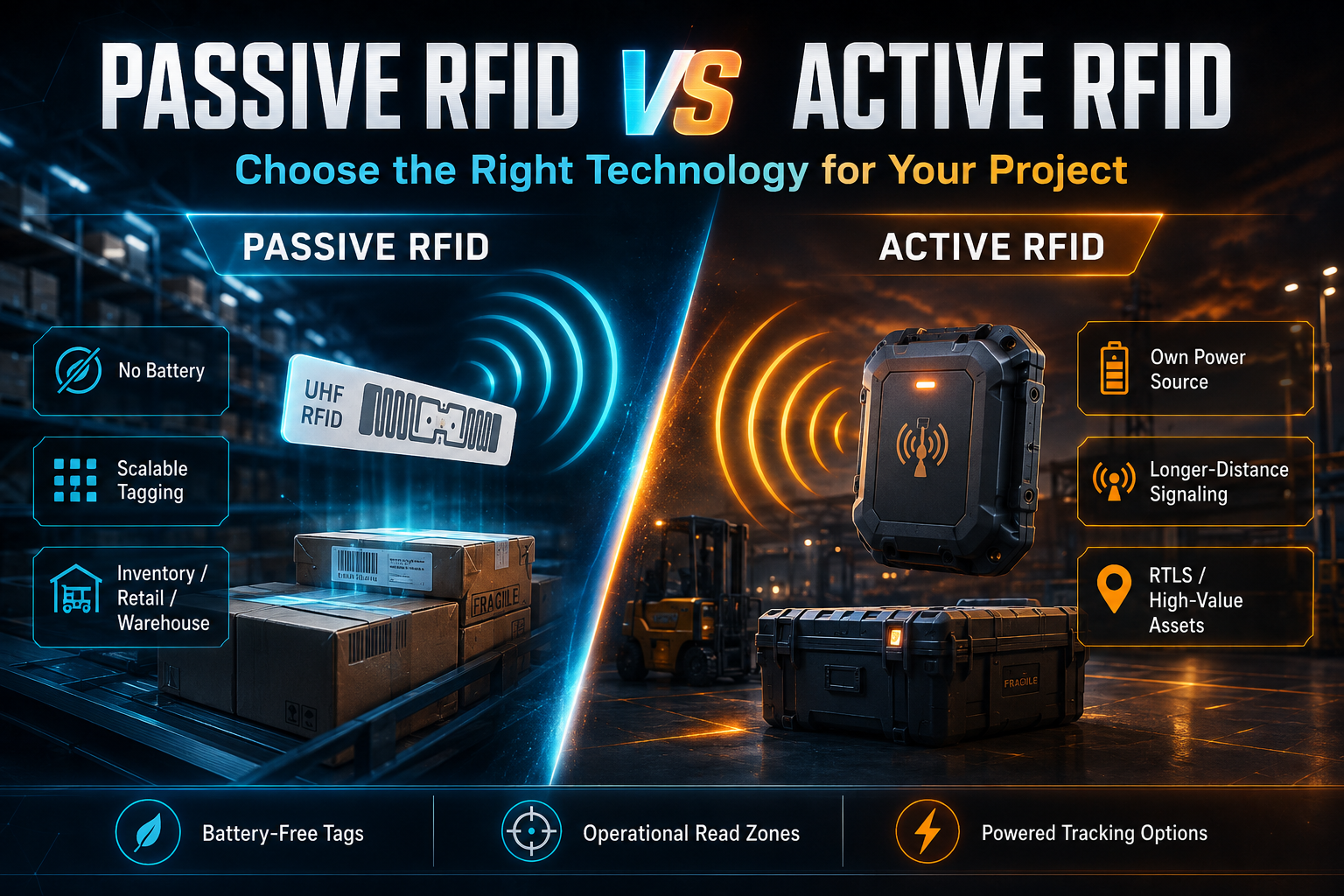
The difference between passive RFID and active RFID starts with one simple engineering question: where does the tag get its power? A passive RFID tag has no onboard battery for normal communication. It receives operating energy from the reader's radio-frequency field and responds using backscatter. An active RFID tag contains its own power source—usually a battery—and a transmitter that can broadcast a signal.
That difference affects tag size, maintenance, infrastructure, read behavior, location capabilities and the economics of tagging thousands—or millions—of physical objects.
So the correct question is not simply “Is active RFID better than passive RFID?” The better question is: “Does the project need scalable identification at configured read zones, or does it need powered tags that can beacon over longer distances?”
Passive RFID vs Active RFID: The Core Difference
Passive RFID
- No onboard battery for normal operation.
- Receives operating energy from the reader's RF field.
- Communicates by backscattering the reader signal.
- Tags can be small, thin and comparatively inexpensive.
- No tag battery replacement program is required.
- Widely used for inventory, retail, logistics and asset identification.
Active RFID
- Contains its own power source, typically a battery.
- Includes a transmitter that can broadcast a signal.
- Can support longer-distance communication than most passive tags.
- Tags are generally larger and more expensive.
- Battery condition and replacement become operational considerations.
- Useful for selected high-value asset and location-oriented applications.
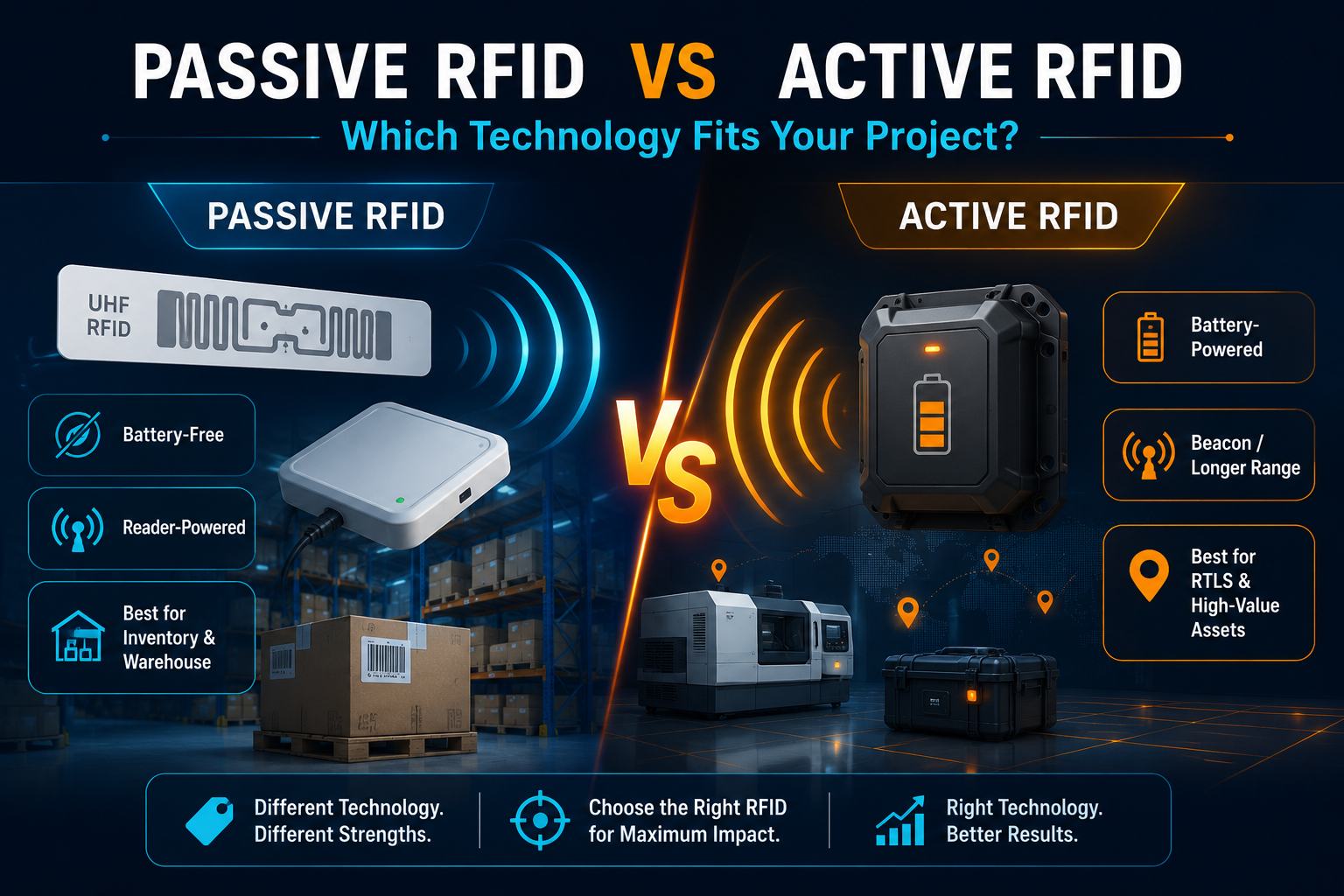
For the passive UHF technology used throughout the GO RFID architecture, see our UHF RFID technology guide.
Passive RFID vs Active RFID Comparison Table
| Factor | Passive RFID | Active RFID |
|---|---|---|
| Tag power | Powered by the reader RF field during communication | Own power source, typically a battery |
| Transmitter | No independent transmitter; responds through backscatter | Has a transmitter and can broadcast its own signal |
| Tag maintenance | No battery replacement | Battery lifecycle must be managed |
| Tag form factor | Can be very small, thin or label-based | Usually larger because of battery and electronics |
| Per-tag economics | Generally better suited to high-volume tagging | Generally higher tag cost |
| Read behavior | Identified when inside a suitable reader field | Can broadcast/beacon depending on the active system design |
| Typical scale | Large populations of inventory and assets | Smaller populations of higher-value assets are common |
| Common applications | Inventory, warehouse, retail, item-level tagging, enterprise assets | Selected RTLS, yards, vehicles, containers, long-distance asset visibility |
| Location model | Read zone / checkpoint / presence architecture; some passive RTLS systems also exist | Often selected when continuous or longer-distance location signaling is required |
How Passive RFID Works
GS1's EPC UHF Gen2 standard defines a passive-backscatter RFID system in which an interrogator—also called a reader—transmits an RF signal to the tag. The tag receives both information and operating energy from that signal. To respond, the tag changes the reflection characteristics of its antenna and backscatters information to the reader.
The tag therefore does not need to maintain a battery simply to identify itself. This is one of the main reasons passive UHF RFID can be used at item level across large inventory populations.
The hardware can include fixed or handheld RFID readers and appropriately engineered RFID antennas and read zones.
How Active RFID Works
An active RFID tag has its own source of power and transmitter. Instead of waiting for the reader's RF field to provide all operating energy, the tag can use its own stored energy to broadcast information according to the system design.
That powered architecture allows active systems to address requirements that are difficult for low-cost passive labels, especially when the business needs longer-distance signaling, beaconing, selected sensor functions or a location infrastructure designed around powered tags.
The trade-off is equally important: batteries increase tag size, tag cost and lifecycle-management requirements. An organization must consider how many active tags exist, how long they are expected to operate, how batteries will be monitored and what happens when a tag reaches the end of its battery life.
Battery-Free vs Battery-Powered: Why It Matters
Do not confuse Battery-Assisted Passive (BAP) tags with fully active tags. RAIN RFID documentation notes that BAP tags can contain a battery while still communicating by backscatter, so they remain passive in the communication sense.
What Is Battery-Assisted Passive RFID?
Between completely passive and fully active RFID is another category commonly called Battery-Assisted Passive (BAP), semi-passive or semi-active RFID depending on the vendor and terminology used.
A BAP tag may use a battery to power the chip or attached sensors, but it still communicates by backscattering the reader signal rather than continuously broadcasting like a fully active transmitter.
This architecture can be useful when a project requires functions such as sensing while retaining passive-style communication behavior. The exact capability depends on the tag design, chip and system architecture.
Passive RFID Is Usually Better for High-Volume Inventory
Inventory economics are one of the strongest reasons passive UHF RFID has become important in retail, warehouses and supply chains.
If a business needs to tag a large population of cartons, apparel items, tools, IT equipment or other physical objects, battery management quickly becomes a major operational issue. Passive tags avoid that problem.
They can also be implemented in label, inlay, hard-tag, on-metal and textile formats depending on the object. Our RFID tag technology guide explains how tag construction and material compatibility affect passive UHF performance.
Passive RFID vs Active RFID for Asset Tracking
Asset tracking is where the choice becomes more nuanced.
If the requirement is to verify whether laptops, computers, tools or other assets are present in configured rooms, checkpoints or read zones, passive UHF RFID can be attractive because many assets can be tagged without maintaining thousands of batteries.
If the requirement is continuous location-style visibility across a large area, longer-distance beaconing or another form of RTLS, an active system—or another location technology—may be more appropriate.
This distinction is important because passive UHF RFID is not automatically GPS. A passive deployment normally tells you that a tagged object was detected at a reader or within a validated read zone. The system architecture determines how that detection is interpreted.
See our commercial RFID asset tracking system and industry overview for enterprise IT and equipment asset visibility.
Passive RFID vs Active RFID for RTLS
The phrase real-time location system (RTLS) is another area where terminology can create confusion. Active RFID has historically been associated with longer-distance location and beaconing because powered tags can transmit their own signal.
However, passive RFID can also support location-oriented architectures when sufficient reader infrastructure and the right system design are used. RAIN Alliance documentation distinguishes passive RTLS from active RTLS and notes that the technologies can serve different location requirements.
The correct project question is therefore not “Does RTLS require active RFID?” Instead ask:
- How precise must the location be?
- How often must location update?
- Is zone-level detection enough?
- How many assets must be tagged?
- Can readers be installed throughout the site?
- Can the business maintain batteries on every tracked tag?
- Does the use case actually require real-time location rather than identification at checkpoints?
Passive RFID for Warehouse and Logistics
Warehouses are usually a strong match for passive UHF RFID because many important business events happen at predictable locations: receiving docks, storage areas, cycle-count routes, outbound gates and conveyor checkpoints.
A passive tag does not need to broadcast continuously. It only needs to respond when it enters the intended RF environment. That can make the architecture efficient for pallet, carton and item identification.
Explore the broader industry context in RFID for warehouse and logistics.
Passive RFID for Retail
Retail item-level RFID is another case where battery-free tags make the economics possible. A powered tag on every individual apparel item would be impractical for most retail operations, while passive labels can be integrated into existing item-identification workflows.
This allows UHF RFID to support inventory counting and store stock visibility while other technologies continue to serve checkout, payments or consumer engagement.
See RFID for retail inventory operations for the commercial use-case perspective.
What About Sensors?
Active and battery-assisted tags can support sensor-oriented use cases because their stored power can operate additional electronics. Examples may include temperature or other environmental measurements, depending on the tag and system.
But sensor capability alone should not force a project into a fully active architecture. Battery-Assisted Passive tags may also support selected sensor functions while retaining backscatter communication. The decision should be based on measurement interval, transmission model, data retention, battery lifecycle and reader infrastructure.
How Middleware Changes the System
Whether the project uses passive or active RFID, raw radio detections are only one part of an enterprise solution. The business system needs useful events such as:
- asset detected in a zone,
- inventory item counted,
- pallet passed an inbound checkpoint,
- tag no longer detected in an expected location, or
- an exception rule was triggered.
For the passive UHF architecture used by GO RFID, the RFID middleware layer can filter repeated reads, add location context and generate structured events. Those events can then be exchanged with enterprise software using an RFID integration architecture.
If the goal is implementation rather than technical education, see the GO RFID API integration solution.
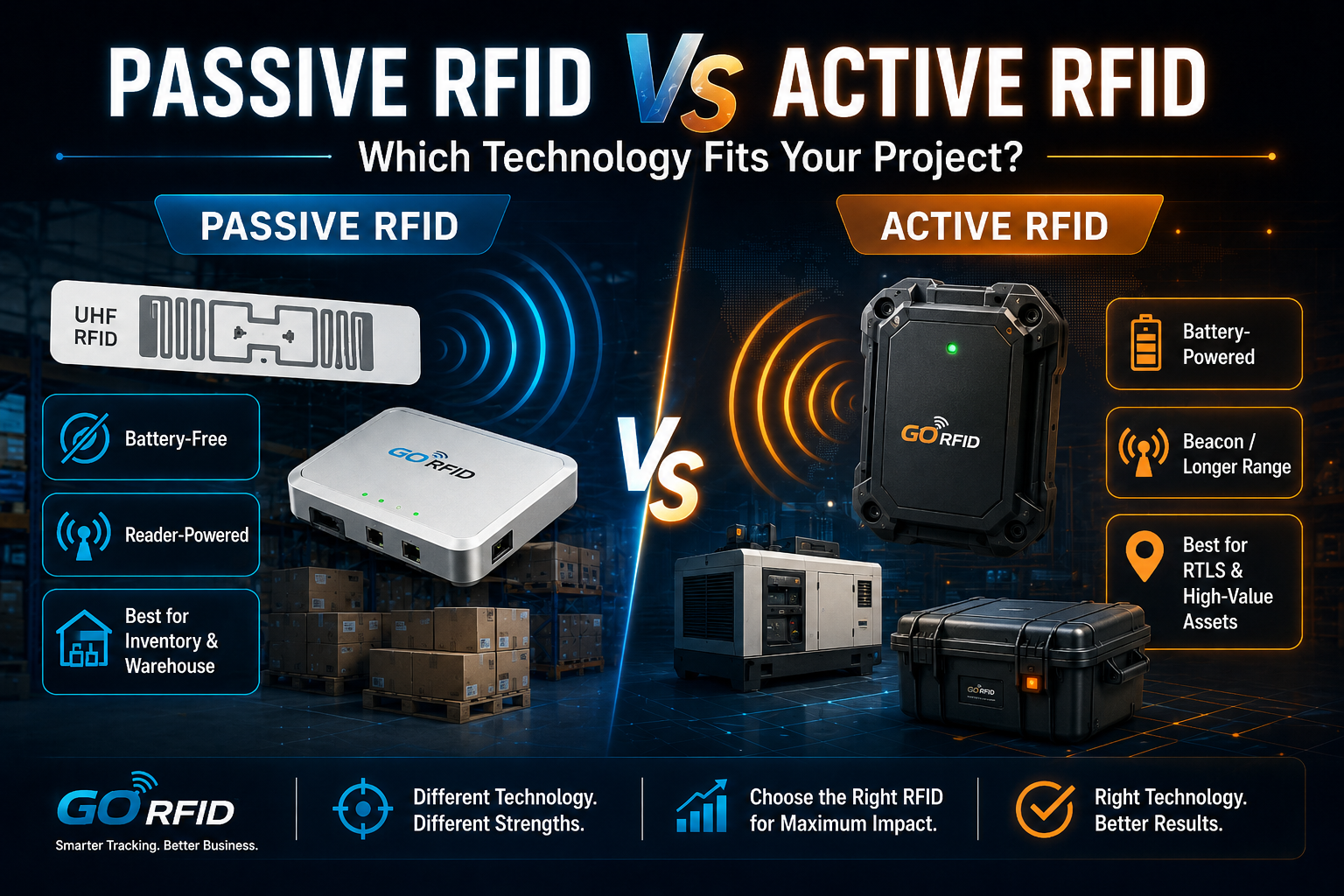
When Should You Choose Passive RFID?
Passive RFID Is a Strong Fit When You Need
- High-volume tagging.
- Inventory and cycle counting.
- Warehouse read zones.
- Item-level retail identification.
- Enterprise asset presence checks.
- Minimal tag maintenance.
- Low-complexity tag form factors such as labels and inlays.
Active RFID May Be a Better Fit When You Need
- Powered tags that can broadcast their own signal.
- Longer-distance signaling than the passive design can reasonably provide.
- Selected RTLS or yard-style location requirements.
- Sensor or beaconing functions that justify battery-powered tags.
- Tracking of a smaller number of higher-value objects where tag cost is acceptable.
9 Questions to Ask Before Choosing Passive or Active RFID
Passive RFID vs Active RFID: Final Verdict
Neither passive nor active RFID is universally better. They solve different classes of problems.
Passive RFID is usually the stronger fit when the goal is scalable identification of inventory, merchandise, warehouse objects and enterprise assets without maintaining batteries on every tag.
Active RFID becomes relevant when a project genuinely requires powered tags, longer-distance signaling, beaconing or location-oriented capabilities that justify higher tag cost and battery management.
For most GO RFID inventory and operational projects, the design starts with passive UHF RFID because it aligns naturally with high-volume identification, fixed read zones, handheld inventory workflows and integration with existing enterprise systems.
Frequently Asked Questions
What is the main difference between passive RFID and active RFID?
Passive RFID tags do not have their own battery for normal communication and receive operating energy from the reader. Active RFID tags have their own power source and transmitter, allowing them to broadcast a signal.
Does passive RFID have a battery?
Standard passive RFID tags do not. Battery-Assisted Passive tags are a separate category that may contain a battery to power the chip or sensors while still communicating through passive backscatter.
Is active RFID always better for asset tracking?
No. If zone-level or checkpoint detection is sufficient and many assets must be tagged, passive RFID can offer better economics and lower maintenance. Active RFID becomes more attractive when the project truly needs powered tags or longer-distance location behavior.
Is passive RFID the same as UHF RFID?
No. Passive describes how the tag is powered. RFID can be passive at different frequency bands. RAIN RFID / EPC UHF Gen2 is a widely used form of passive UHF RFID for inventory and item identification.
What is Battery-Assisted Passive RFID?
BAP tags contain a battery that can power the chip or sensors, but the tag still communicates using backscatter. RAIN Alliance documentation therefore distinguishes BAP from fully active transmitter-based RFID.
Can passive RFID be used for RTLS?
Yes, passive location-oriented systems exist, but their architecture and update model differ from powered active RTLS systems. The right choice depends on required location precision, update frequency, tag volume and reader infrastructure.
Which RFID type is better for warehouse inventory?
Passive UHF RFID is generally the more relevant architecture for high-volume warehouse inventory because tags are battery-free and can be read by handheld or fixed UHF readers within designed RF environments.
Does passive RFID mean zero maintenance?
The tag itself does not require battery replacement, but the overall system still requires normal maintenance of readers, antennas, network, software and physical tag attachment.
Planning a Passive UHF RFID Project?
GO RFID by MTM Solusindo focuses on enterprise UHF RFID architecture for inventory tracking, warehouse operations, asset visibility and integration with existing software. A project can combine tags, fixed or handheld readers, antennas, middleware and APIs according to the physical workflow.